Pro SWPPP – America’s #1 SWPPP Service helps contractors across the country stay compliant with stormwater rules, and if you’re building in Travis County, Texas, you need to know exactly what’s required before you break ground. One slip-up can cost you tens of thousands of dollars in fines, stop your project cold, and put you on TCEQ’s radar. The good news? Travis County SWPPP requirements aren’t rocket science once you understand the basics, and we’re going to walk through exactly what you need, when you need it, and how to get it done fast.
What Is a SWPPP and Why Does Travis County Care?
A Stormwater Pollution Prevention Plan (SWPPP) is a document that shows how you’ll keep dirt, mud, oil, and other junk from washing off your construction site into streets, creeks, and rivers. Under the Clean Water Act and the National Pollutant Discharge Elimination System (NPDES) program, the Texas Commission on Environmental Quality (TCEQ) enforces these rules for the entire state, including Travis County.
Travis County sits in a sensitive watershed area. Rain washes sediment into Barton Springs, Lady Bird Lake, and the Colorado River. Those waterways feed drinking water and recreation for Austin and beyond. TCEQ and local officials don’t mess around when it comes to protecting them. If your site disturbs one acre or more of land, you’re required to have a SWPPP and coverage under the Construction General Permit (CGP) TXR150000 before you start moving dirt.
When Do You Need a SWPPP in Travis County?
Here’s the rule: If your project disturbs one acre or more—or if it’s part of a larger common plan of development that adds up to one acre—you need a SWPPP. That means if you’re building a subdivision, clearing land for a commercial building, or grading a parking lot, you’re likely covered.
For projects between one and five acres, you must prepare a site-specific SWPPP and post a Construction Site Notice at the site. For projects larger than five acres, or part of a larger common plan, you also need to file a Notice of Intent (NOI) with TCEQ through the STEERS online system at least 48 hours before you start construction. The NOI fee is $225, and it officially registers your project under the CGP.
Even if your project is under one acre, don’t assume you’re off the hook. Travis County and the City of Austin have their own Municipal Separate Storm Sewer System (MS4) permits, and they can require erosion control plans or local permits for smaller sites, especially near sensitive watersheds or critical environmental features. Always check with the local jurisdiction before you assume state rules are all you need.
What Goes Into a Travis County SWPPP?
A SWPPP isn’t a one-page checklist. TCEQ expects a complete, site-specific plan that covers every detail of your project. Here’s what must be in it:
- Site Description: Your plan must describe the site’s topography, soil types, drainage patterns, and what kind of construction activity you’re doing.
- Site Map: A detailed map showing property boundaries, drainage paths, locations of Best Management Practices (BMPs), and any nearby waterways or storm drains.
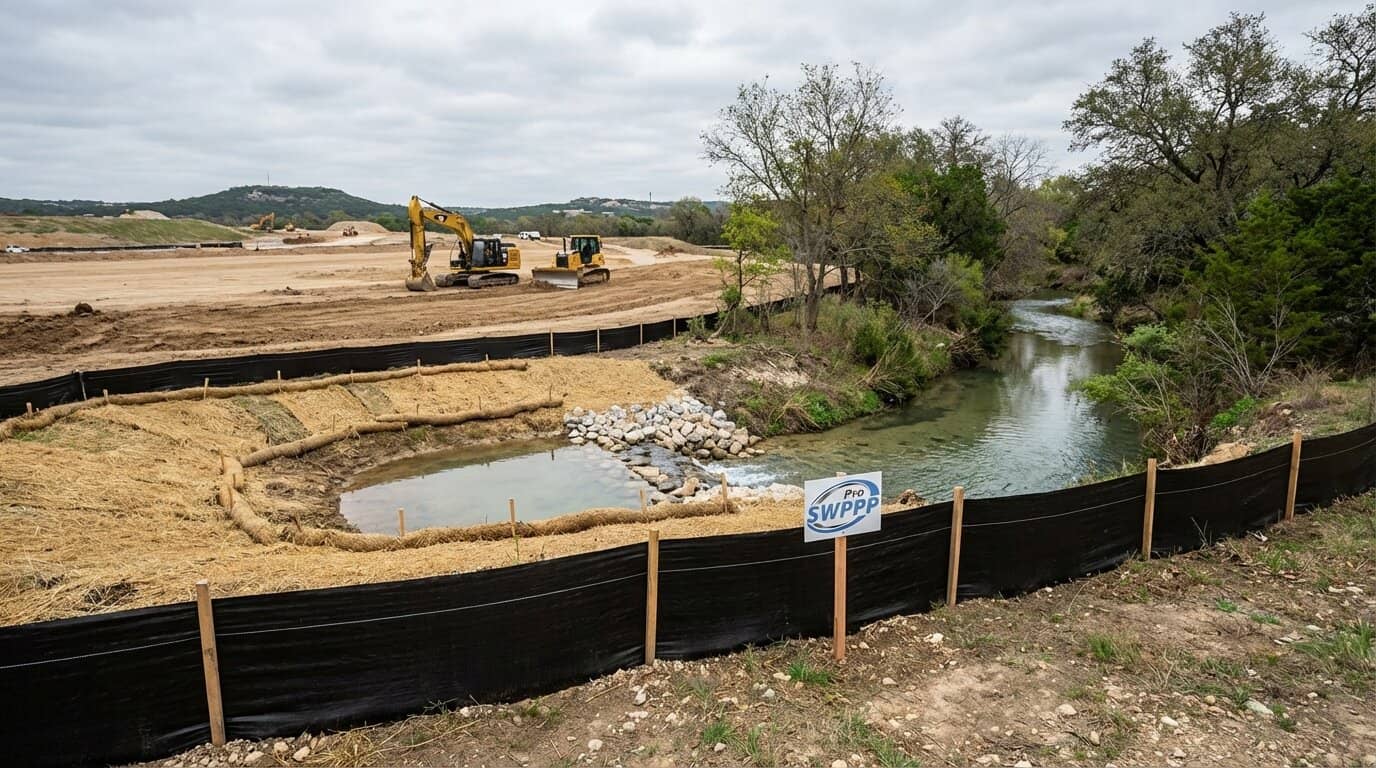
- Best Management Practices (BMPs): Specific erosion control and sediment control measures like silt fences, rock check dams, stabilized construction entrances, inlet protection, and cover for stockpiles.
- Inspection and Maintenance Schedule: You must inspect your site every 14 calendar days and within 24 hours after any rain event that drops at least half an inch. Document every inspection in writing.
- Roles and Responsibilities: Name the people responsible for installing, inspecting, and maintaining BMPs, and provide contact information.
- Record Keeping: Keep all inspection reports, maintenance logs, and plan updates on-site and available for TCEQ inspectors.
- Final Stabilization Plan: Describe how you’ll achieve 70 percent vegetative cover or equivalent permanent stabilization before you can file a Notice of Termination (NOT).
Pro SWPPP – America’s #1 SWPPP Service prepares hundreds of site-specific SWPPPs every year for contractors in Texas and across the country. Our CPESC-certified experts know Travis County soil types, local BMPs, and exactly what TCEQ inspectors look for. We make sure your plan is bulletproof from day one.
Travis County and Austin-Specific Rules
If your project is inside Austin city limits or under Travis County jurisdiction, you face extra layers of compliance. The City of Austin requires a separate Land Disturbance Permit for projects disturbing 2,500 square feet or more. You’ll submit an erosion control plan with your permit application, and the city will inspect your site to make sure you’re using the right BMPs.
Austin also has strict rules about work near critical water quality zones, the Barton Springs Edwards Aquifer Recharge Zone, and Lady Bird Lake. If your site is in one of those zones, expect tighter controls, more frequent inspections, and possible requirements for enhanced BMPs like sediment basins or temporary seeding.
Travis County enforces similar rules in unincorporated areas. The county’s Transportation and Natural Resources department reviews erosion control plans and issues permits for construction in the right-of-way or near county infrastructure. Even if you already have TCEQ CGP coverage, you still need local permits and approvals.
Don’t want to mess with all the paperwork and requirements? Check out Order your SWPPP now with Pro SWPPP Professional CPESC Certified SWPPP Services.
Best Management Practices (BMPs) for Travis County Sites
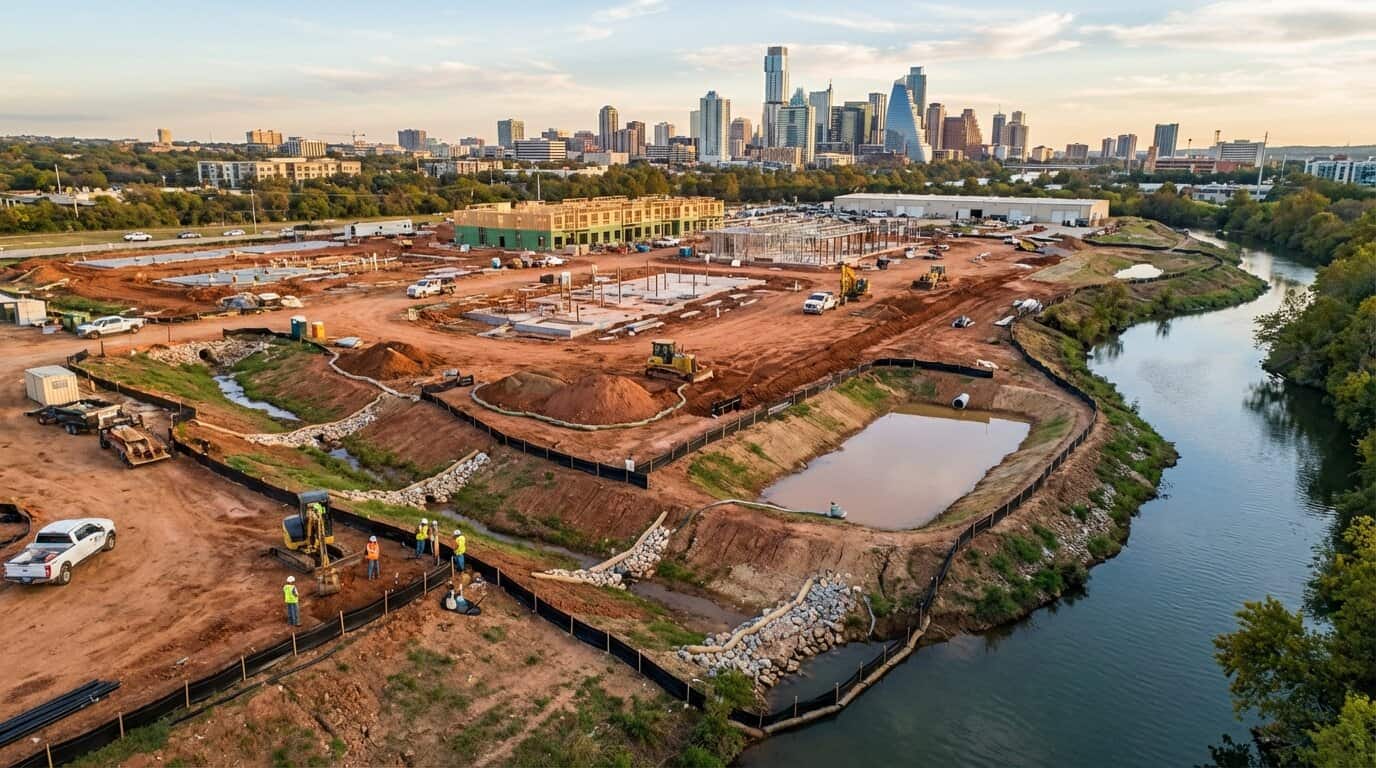
Travis County’s clay soils and heavy rain events mean you need solid erosion control and sediment control measures. Here are the most common BMPs you’ll see on compliant sites:
- Silt Fences: Installed along the downslope perimeter to trap sediment before it leaves the site.
- Stabilized Construction Entrances: Rock pads at site access points to knock mud off tires and prevent tracking onto public roads.
- Inlet Protection: Filter fabric or gravel bags around storm drain inlets to catch sediment before it enters the drainage system.
- Temporary Seeding and Mulch: Cover disturbed soil that won’t be worked for more than 14 days to prevent erosion.
- Rock Check Dams: Placed in drainage swales to slow water flow and trap sediment.
- Dust Control: Water trucks or mulch to keep dust from becoming airborne during dry periods.
The 2023 CGP, which took effect March 5, 2023, requires you to install BMPs before you start any land disturbance. If you wait until after grading to put up a silt fence, you’re already out of compliance. TCEQ can fine you up to $32,500 per violation per day, and trust me, they will.
Inspections, Maintenance, and Record Keeping
Here’s where most contractors trip up: inspections and documentation. You must inspect your site every 14 calendar days and within 24 hours of any storm that drops half an inch or more of rain. During each inspection, you check every BMP, look for signs of erosion or sediment leaving the site, and make repairs immediately if something’s broken.
Every inspection gets documented in writing. Your inspection report must include the date, weather conditions, what you found, and what repairs you made. Keep these reports in a binder on-site, because if TCEQ shows up unannounced, they’ll ask to see them. If you can’t produce current inspection logs, you’re in trouble.
Pro SWPPP – America’s #1 SWPPP Service offers inspection services and remote support to keep your records clean and your site compliant. We know exactly what TCEQ wants to see, and we make sure you’re never caught short.
Filing Your NOI and NOT
If your project is over five acres or part of a larger common plan, you file an NOI through the STEERS system at least 48 hours before construction starts. The NOI registers your project under the CGP and assigns you a tracking number. You’ll post your Construction Site Notice with that tracking number at the site entrance where it’s visible from the street.
When your project is complete and you’ve achieved final stabilization—70 percent vegetative cover or equivalent permanent measures like pavement or landscaping—you file a Notice of Termination (NOT). The NOT officially ends your CGP coverage and closes out your TCEQ obligations. Most projects take six to 18 months from NOI to NOT, depending on size and weather.
Not sure what your project needs? Take our SWPPP Quiz (link) or Schedule a Free SWPPP Consultation with CPESC Certified SWPPP Expert Derek E. Chinners.
Common Mistakes and How to Avoid Them
Contractors in Travis County make the same mistakes over and over. Here’s what to avoid:
- Starting work before filing the NOI: TCEQ will shut you down and fine you. File at least 48 hours early.
- Using a generic SWPPP: Cookie-cutter plans fail inspections. Your SWPPP must be site-specific, with accurate maps and BMPs that match your soil and drainage.
- Skipping inspections: Missing a 14-day or post-rain inspection is a violation. Calendar reminders and a disciplined routine are your friends.
- Poor BMP installation: A silt fence that’s not trenched in or a rock entrance that’s too thin won’t work. Install BMPs correctly the first time.
- No subcontractor training: Everyone working on-site must understand BMP requirements. Hold a quick meeting and document attendance.
Real example: A contractor in the Austin area started grading before posting silt fences. A half-inch rain hit that night, and sediment washed into a neighborhood storm drain. TCEQ showed up, issued a violation, and fined the contractor $15,000. The project was delayed three weeks while they fixed the erosion and re-submitted a corrected SWPPP. All of that could have been avoided with proper planning and BMP installation before the first day of work.
Why Work With Pro SWPPP?
Pro SWPPP – America’s #1 SWPPP Service has prepared thousands of SWPPPs for contractors in Travis County, across Texas, and nationwide. We’re CPESC-certified, we know TCEQ rules inside and out, and we deliver site-specific plans that pass inspection the first time. Our team handles NOI filing, inspection support, plan updates, and NOT filing, so you can focus on building instead of paperwork.
We also serve contractors in Georgia and other states with similar stormwater programs. Whether you’re building in Austin, Atlanta, or anywhere in between, we make compliance simple, fast, and affordable. Learn more about our team and our process, or contact us for a custom quote.
Resources and Next Steps
For official guidance, visit the EPA NPDES Construction Stormwater page and the TCEQ CGP page. Download the latest CGP and SWPPP templates, and review the Small Business and Local Government Assistance (SBLGA) resources.
If you’re ready to get your project permitted and compliant, reach out to Pro SWPPP – America’s #1 SWPPP Service today. We’ll walk you through every step, prepare your SWPPP, file your NOI, and keep you on track from groundbreaking to final stabilization. Travis County SWPPP requirements don’t have to slow you down—not when you’ve got the right team on your side.
FAQ
Do I need a SWPPP if my project is under one acre in Travis County?
State rules require a SWPPP only for sites one acre or larger. But Travis County and the City of Austin can require erosion control plans or local permits for smaller projects, especially near sensitive watersheds. Always check with your local jurisdiction before you assume you’re exempt.
How much does it cost to prepare a SWPPP in Travis County?
Professional SWPPP preparation typically costs a few thousand dollars, depending on project size and complexity. The TCEQ NOI filing fee is $225 for projects over five acres. The real cost is the tens of thousands in fines you avoid by staying compliant from day one.
What happens if I don’t file an NOI or skip inspections?
TCEQ can issue violations and fine you up to $32,500 per violation per day. Inspectors will shut down your project until you correct the problem, and you’ll have a compliance record that follows you on future projects. It’s not worth the risk.
Can I use the same SWPPP for multiple projects in Travis County?
No. Every SWPPP must be site-specific, with accurate maps, soil descriptions, drainage patterns, and BMPs tailored to that exact location. A generic or copied plan will fail inspection and put you out of compliance.
How long does it take to get TCEQ CGP coverage?
You must file your NOI at least 48 hours before you start construction. TCEQ processes the NOI quickly, but you’re responsible for having your SWPPP complete and your BMPs installed before you disturb any land. Plan ahead and file early to avoid delays.
Get your Travis County SWPPP done right the first time with Pro SWPPP – America’s #1 SWPPP Service.
1970-01-01 00:00:00posthttps://proswppp.com/?p=10242draftwhat-are-travis-county-swppp-requirements-200